
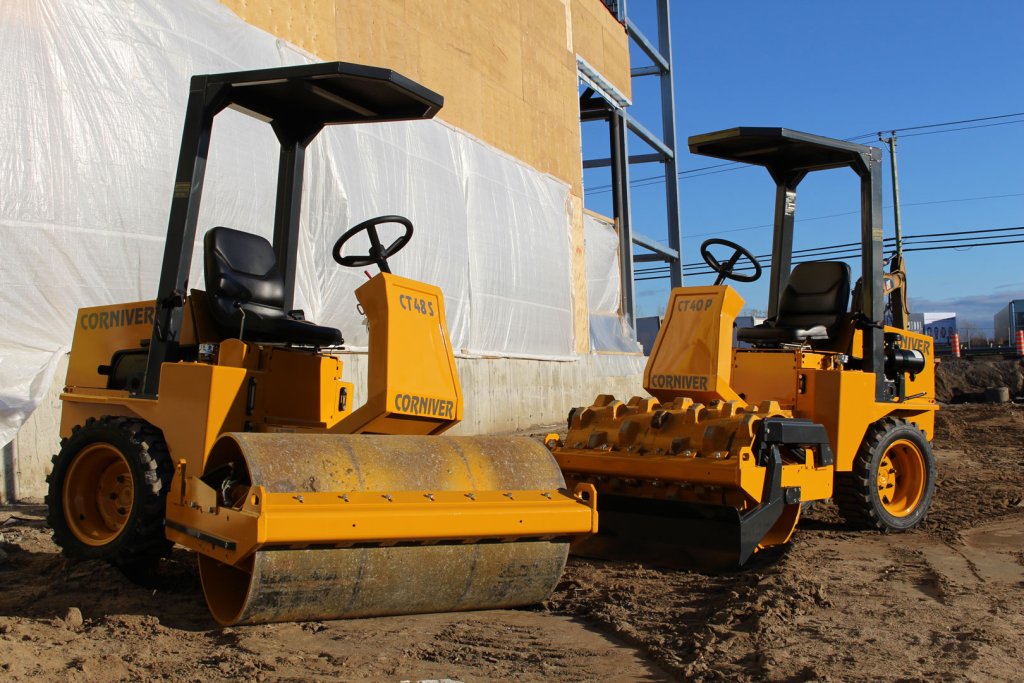
The drum you pick comes down to one detail more than any other: the soil you’re compacting. Granular materials like sand, gravel, and crushed stone, plus asphalt, go to a smooth drum. Sticky, fine-grained materials like clay and silt (cohesive soils) go to a pad-foot. Get that match right and you hit density in fewer passes. Get it wrong and you can roll all day and still leave a soft layer hiding under a firm-looking surface.
This guide walks through how each drum works, and which roller belongs on which job. There’s a quick-reference table further down if you want to skip straight to it. By the end you’ll know how to choose the right compaction roller for what’s in front of you, and whether you need one machine or two.
How does a smooth drum roller compact soil?
A smooth drum compacts from the top down using its own weight plus vibration. The drum is a single smooth steel cylinder. It presses down with static weight, and on a vibratory machine a spinning weight inside the drum adds a fast hammering force on top of the static weight. Together, that pressure and vibration shake granular particles loose and let them settle into a tighter arrangement, with the small particles filling the gaps between the big ones.
On a vibratory roller, that shaking force matters far more than the static weight. A Corniver roller, for example, carries about 3,700 lbs of static weight but generates roughly 15,000 lbs of centrifugal force once the drum is vibrating. The vibration is doing most of the compaction, not the dead weight of the machine.
That’s exactly why smooth drums are the right call for granular, non-cohesive material. Sand, gravel, and crushed stone don’t stick together. They just need to be shaken into their densest packing, and vibration does that well. According to the FHWA’s geotechnical manual (NHI-05-037), smooth drum rollers are best suited for granular, relatively non-cohesive soils. The same goes for asphalt, which gets compacted with smooth drums because the drum seals the mat into a tight, even surface.
The Corniver rollers are compact ride-on single-drum machines in a smooth drum configuration, built for this kind of work. The whole design philosophy is a high centrifugal force in the smallest possible package, which matters when you’re compacting granular base in a trench or a tight footprint where a full-size roller won’t fit.
How is a pad-foot drum different?
A pad-foot drum compacts from the bottom of the layer up, and it does it with an extra force a smooth drum can’t produce. Instead of a smooth cylinder, the drum is covered in rows of protruding steel pads, or “feet.” Because each foot is small, all the machine’s weight gets concentrated onto those little contact points, which drives them down into the soil instead of riding on top of it.
The imprints left by the feet also increase the contact area between the ground and the air, which allows water to evaporate faster. The drum’s vibration brings the water up to the surface, so that evaporation matters. Removing water from the soil is one of only two ways to compact sticky material.
One word worth knowing here is “lift,” because it comes up constantly on a fill job. You don’t dump three feet of dirt and roll it once. A roller can only compact so deep, so you build the soil up in thin layers and pack down each one before adding the next. Each of those layers is a lift, usually somewhere between 6 and 12 inches. Think of it like building lasagna one layer at a time instead of all at once.
Here’s why pad-foot drums exist: a smooth drum struggles on clay. Press a smooth steel drum onto a lift of clay and it firms up the top while the bottom of the lift stays soft and humid, a bit like stamping your boot on fresh snow, where the surface packs down hard while the powder underneath stays loose. Worse, sealing the top traps the air and moisture that need to escape from below, so the bottom never gets dense. A pad-foot fixes this because the feet punch through the top of the lift and push the force down into the middle and bottom, compacting the layer from the inside.
The feet also knead the soil as they go in and come out, like working bread dough. That kneading breaks up clumps and squeezes out trapped air and water, increasing the density. Equipment engineers describe this as a fourth force. A smooth vibratory drum gives you three forces (static pressure, impact, and vibration). A pad-foot drum gives you those same three plus a manipulative, or kneading, force (per Caterpillar’s drum-selection guidance, reported by Equipment World). That kneading is the whole reason pad-foot drums win on cohesive soil.
Pad-foot vs. sheepsfoot: are they the same thing?
In everyday job-site talk, “pad-foot” and “sheepsfoot” get used as if they mean the same machine, but technically they’re slightly different in the shape of the feet. A classic sheepsfoot has longer, skinnier cylindrical feet that dig in deep and tend to fluff up the top of the lift as they pull out. A pad-foot (also called a tamping foot) has shorter feet with a tapered, oval or rectangular face that’s wider at the base. Those tapered pads are shaped to pull cleanly back out of the soil without dragging the top layer loose, so they leave a better surface behind (per the engineering overview at ScienceDirect and Caterpillar’s pad guidance via Equipment World).
Both do the same core job, kneading and compacting cohesive soil from within. The difference is mostly in the finish they leave and how aggressively they penetrate. For most modern compaction work, the pad-foot is the practical choice, which is the configuration Corniver builds. So when you see “sheepsfoot” used loosely in spec sheets or rental listings, it’s usually pointing at the same family of cohesive-soil rollers.
Which roller for which soil? (Quick-reference guide)
The simplest rule to remember: granular and asphalt go to smooth drum, cohesive clay and silt go to pad-foot. Here’s the breakdown by material and the common jobs that go with each.
| Material / Job | Right drum | Why |
|---|---|---|
| Sand, gravel, crushed stone | Smooth drum | Vibration shakes granular particles into their tightest packing |
| Granular base and sub-base (roads, parking lots) | Smooth drum | Even, top-down compaction on non-cohesive material |
| Asphalt | Smooth double drum | Seals the mat into a tight, even surface; pad-foot would punch holes in it |
| Finished subgrade before paving | Smooth drum | Leaves the flat, sealed surface paving needs |
| Clay and silt | Pad-foot | Kneads and compacts cohesive soil from the bottom of the lift up |
| Structural fills and embankments | Pad-foot | Deep compaction plus a textured surface that bonds lifts together |
| Trench backfill in cohesive soil | Pad-foot | Reaches the bottom of the lift that a smooth drum can’t |
| Wet or sticky ground, high water table | Pad-foot | Feet knead and don’t pick up sticky soil the way a smooth drum does |
One note on mixed soil, the kind that’s part sand and part clay. There’s no single perfect drum for it, so the common approach is to compact with a pad-foot first to get the cohesive material dense, then finish with a smooth drum to seal the surface. More on that sequence below.
What happens if you use the wrong drum?
Using the wrong drum doesn’t just slow you down, it can leave you with insufficient compaction that looks fine until it fails. Run a smooth drum on clay and it bridges across the top, firming up a thin crust while the soil underneath stays soft and full of trapped air and moisture. That hidden soft layer is what later settles and cracks the slab or pavement sitting on top of it.
Go the other way and run a pad-foot on clean sand or gravel, and the feet just churn the material around instead of compacting it. There’s nothing cohesive for the kneading action to work on, so you end up tilling the ground rather than densifying it. Corniver’s pads are an exception worth noting. They’re designed to work like gear teeth, going in and out cleanly and leaving the edges intact without disturbing the soil around them. Because of that, a Corniver pad-foot roller can also be used to compact sand. The only catch is that the top layer will be left with the marking of the feet.
Why does a pad-foot leave a rough surface, and is that a problem?
A pad-foot leaves a rough, dimpled surface on purpose, and on the right job that roughness is doing real work. Each foot leaves an indentation, so a finished pad-foot lift looks pockmarked. When you place the next lift of soil on top, that rough surface gives the new material something to grip into, and the two layers lock together instead of sitting on each other like stacked plates. In structural fills and embankments, that interlift bond matters, because you don’t want layers that can slide or separate. As the New Mexico Office of the State Engineer’s dam specifications note, the rough surface helps each new lift adhere to the one below and reduces the smooth seams that can turn into weak points or seepage paths.
A smooth drum does the opposite. It leaves a flat, sealed, level surface, which is exactly what you want for a finished subgrade before paving or for the final grade on a lot. The Cat Rental Store sums up the trade-off plainly: smooth rollers leave a flat, level surface ideal for paving, while pad-foot rollers leave a rougher profile that’s better for structural stability.
This is why the two drums often work as a sequence on the same job. On cohesive or mixed ground, you compact the deeper structural lifts with a pad-foot to get density and good bonding, then switch to a smooth drum to seal the surface for whatever goes on top. Pad-foot for the muscle work, smooth drum for the finish.
Which machine should I get, and do I need two?
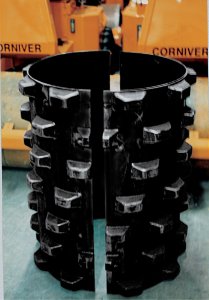
For most operations, you don’t need two separate machines, because one smooth drum roller with an add-on padded shell kit covers both jobs. A padded shell kit is a set of pads that bolts over the smooth drum to turn it into a pad-foot for cohesive work, then comes back off when you’re back on granular material. Corniver offers an easy-to-install padded shell kit as an add-on for its smooth single-drum rollers, so one machine handles clay backfill on Monday and granular base on Tuesday.
That convertible setup is the right answer for some contractors and rental fleets that see a mix of soils and want one versatile machine instead of two specialized ones. For a rental center, it also means a single unit in the yard can satisfy two different rental requests, which is better utilization on the same capital outlay.
Realistically, though, if you’re on heavy clay continuously, day in and day out, a machine built around dedicated pad-foot work will outperform a smooth drum wearing a shell kit, because the pad geometry and weight balance are purpose-made for it. The convertible approach is built for versatility across changing soils. Continuous heavy cohesive work is its own case. Corniver’s lineup, the CT40 (40″ wide), CT48 (48″ wide), and CT55 (55″ wide, the newest model), is built compact and maneuverable for tight spots like trenches and building interiors, where the soil mix tends to vary and a convertible machine earns its keep.
Frequently asked questions
Can I use a smooth drum roller on clay? You can run it, but you won’t get anywhere near good compaction, not even close. A smooth drum seals the top of a clay lift and leaves the bottom soft, trapping air and moisture below. For clay and silt, a pad-foot kneads and compacts the full lift, which is what cohesive soil needs.
Can I use a pad-foot roller on sand or gravel? No, it’s the wrong tool for granular material. The feet churn loose sand and gravel around instead of compacting them, because there’s nothing sticky for the kneading action to grab. Use a smooth drum on granular material such that vibration can settle the particles tight. That said, Corniver’s pad-foot rollers are designed to leave the edges intact, so they can be used to compact sand, provided the flatness of the top layer isn’t an issue.
What roller do I use for asphalt? A smooth double drum designed for asphalt, with the matching vibration frequency and force, always. The smooth steel surface seals the asphalt mat into a tight, even finish.
What’s the best roller for trench backfill? It depends on the backfill material. For cohesive soil like clay, a pad-foot reaches the bottom of the lift that a smooth drum can’t. For granular backfill, a smooth drum is better. A compact ride-on roller like Corniver’s CT40 fits the tight width of most trenches.
Is a pad-foot the same as a sheepsfoot roller? They’re close and the terms get used interchangeably, but the feet are shaped differently. A sheepsfoot has longer cylindrical or oval feet, while a pad-foot has shorter tapered pads that leave a cleaner surface. Both knead and compact cohesive soil. Corniver builds the pad-foot style.
Why does a pad-foot leave a bumpy surface? Because the feet press indentations into the soil, and that roughness is useful. On a structural fill, the rough surface helps the next lift bond to the one below. If a smooth finish is required on top, just follow the pad-foot with a smooth drum.
What is a “lift” in compaction? A lift is a layer of soil that you compact before adding the next layer, usually around 6 to 12 inches. Corniver rollers can compact layers thicker than 12 inches, depending on the material and its water content. You build fills up in lifts because a roller can only compact so deep at once. Compacting layer by layer is what gets you solid ground all the way down.
Do I need both a smooth drum and a pad-foot roller? A smooth drum roller with an add-on padded shell kit converts between both jobs, which covers most operations that see mixed soils. A dedicated pad-foot still wins for continuous heavy clay work, but for varied job sites, one convertible machine is the more practical buy.
Which drum is better for mixed soil that’s part sand and part clay? There’s no single perfect drum, so the usual approach is to compact with a pad-foot first to densify the cohesive material, then finish with a smooth drum to seal the surface. A convertible machine with a shell kit lets you do both passes with one roller, even though the padded shell machine has somewhat lower compaction performance than a dedicated drum.
The bottom line
Choosing a compaction roller is mostly about reading the soil. Granular material and asphalt require a smooth drum and its top-down vibration. Clay and silt require a pad-foot and its kneading force that compacts from the bottom of the lift up. Match the drum to the material and you save passes, achieve density, and avoid the soft hidden layer that comes back to complicate your day. For job sites that require both, a smooth single-drum roller with a padded shell kit can be a good fit, to give you both tools in one machine.
Want to see which compact roller fits your work? Compare the rollers or request a quote.
 English
  Français du Canada
  Español de México
  Português do Brasil